

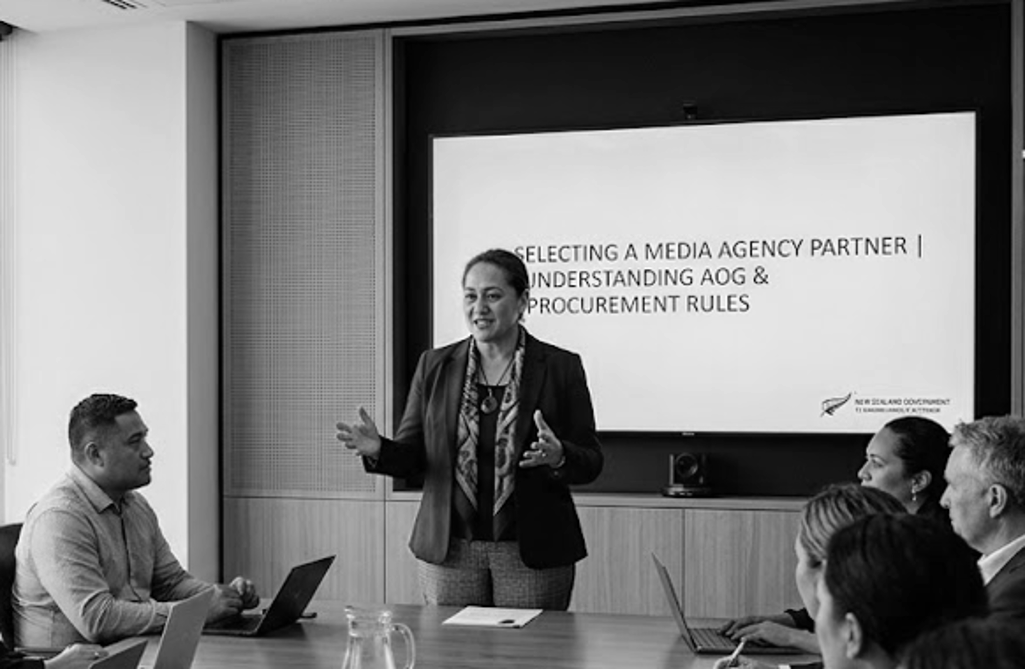
A procurement-aligned guide to evaluating media planning and buying partners under the All-of-Government framework.
Last updated: August 2026 · Published by The Media Lab, Wellington
Quick answer
New Zealand government agencies should choose a media agency through the All-of-Government (AoG) Creative and Media Services contract, then run a secondary procurement process that evaluates providers on public-sector experience, behaviour-change strategy capability, transparent reporting, and channel integration, not price alone. The Government Procurement Rules (5th edition, effective December 2025) require this decision to be fair, proportionate, and to deliver measurable public value.
Selecting a media agency is a decision that affects public funds, communication effectiveness, and ultimately the delivery of public services. For New Zealand government agencies, that decision sits inside a defined procurement framework, and getting the selection criteria right matters as much as following the process correctly.
What Is the Government Procurement Framework for Media Agencies?
New Zealand's public sector selects media agencies within the Government Procurement Rules, the Government's minimum expectations for how public servants spend public money. The current 5th edition took effect on 1 December 2025 and applies to all mandated government agencies.
The framework rests on six core principles:
• Plan and manage for great results
• Be proportionate and right-size the procurement
• Be fair to all suppliers
• Get the right supplier
• Get the best deal for everyone
• Engage with businesses responsibly
The Government Procurement Rules are supported by the Government Procurement Charter, which directs agencies to deliver economic benefits to New Zealand, seek innovative solutions, and manage risk appropriately while promoting inclusive economic development.
What Is the All-of-Government (AoG) Creative and Media Services Contract?
For most government agencies, the procurement journey for a media agency begins with the All-of-Government (AoG) Creative and Media Services (CMS) contract, a consolidated panel that merged the previous separate advertising and design services contracts. It covers content production, creative services, media strategy, cultural competency, and social media services.
Key benefits of starting with the AoG contract:
• Discounted rates: agencies can save up to 20% compared with standard market rates, according to New Zealand Government Procurement
• Access to a vetted panel of providers, removing the need to run a full open-market procurement process from scratch
• Performance ratings and surveys that help agencies choose reliable providers based on actual track record
“The AoG contracts save agencies money, time and effort by leveraging government's collective purchasing power.”
New Zealand Government Procurement
However, the AoG panel is the starting point, not the finish line. Agencies still need to run a secondary procurement process to select the right provider from the panel for their specific campaign or programme.
What Criteria Should Government Agencies Use to Select a Media Agency?
Beyond AoG panel membership and cost, six criteria consistently separate a genuinely capable government media partner from a generalist one:
1. Understanding of the New Zealand market context
2. Behaviour-change media strategy capability
3. A demonstrated public sector track record
4. Ability to integrate paid and unpaid channels
5. Ownership structure: global network vs. local independent
6. Transparent, decision-useful reporting
Each is explained below.
1. Does the Agency Understand New Zealand's Market Context?
A media agency operating in New Zealand's public sector needs more than global tools; it needs a working understanding of local audiences, media ownership, and community media channels.
“You won't find us shoehorning global data sets and tools into campaigns but rather applying our understanding of the nuances of NZ businesses, bringing ideas to life through clever use of media.”
Matt McNeil, Managing Director, The Media Lab
2. What Is Behaviour-Change Media Strategy, and Why Does Government Need It?
Behaviour-change media strategy is the practice of using paid and owned media to motivate a specific public action, rather than to build brand awareness or sell a product. It is the core skill government communications require, because most government campaigns exist to shift behaviour: filing a tax return, completing a bowel screening test, or applying for a benefit entitlement on time.
“We aren't selling widgets or building brands. Media for Government is about shifting behaviour and motivating the public to take actions, whether it's paying your taxes on time or sending your bowel screening test in.”
Antony Young, Communications Planning Director, The Media Lab (which works with Inland Revenue and the National Bowel Screening Programme)
3. How Important Is Public Sector Experience?
Experience working with government agencies matters because public sector communications carry considerations that don't apply to commercial campaigns, including:
• Adherence to government procurement rules
• Transparency and accountability requirements
• Cultural competency and te reo Māori integration
• Accessibility standards
• Public scrutiny and reputational sensitivity
Ask prospective agencies for case studies demonstrating successful government campaigns, and request references from current public sector clients.
4. Why Does Channel Integration Matter for Government Campaigns?
Modern government communications need to work seamlessly across paid, owned, and earned channels to reach diverse New Zealand audiences, including specific cultural audiences and demographic groups that a single-channel approach won't reach.
“The Media Lab were able to bring together creative and media seamlessly. That ability to integrate paid and unpaid channels brought value and impact far beyond standard spots and dots.”
Adele Fitzpatrick, CEO, Museums Aotearoa
5. Should Government Choose a Global Network Agency or a Local Independent?
Government agencies historically defaulted to global network agencies, firms owned by holding companies such as Omnicom or Publicis. Over the past decade, local independent agencies have established themselves in the Wellington market with senior, experienced media operators who have built a substantial body of government work.
Global network agency
Senior staff often move to strategy; day-to-day work can shift to junior teams
Global platforms and data sets, not always calibrated to NZ audiences
May combine planning and buying with rebate or trading-desk incentives
Local independent agency
Principals typically remain hands-on for the life of the account
Local audience and channel knowledge built specifically for NZ context
Independence from global trading arrangements supports transparent, ring-fenced planning
“We're committed to the market, and won't hand off to a junior level team once the agency appoints us.”
Matt McNeil, Managing Director, The Media Lab
6. Does Media Buying Scale and Clout Still Matter?
Scale and buying power are often cited as reasons to choose a large network agency, but the picture is more nuanced for government buyers:
• Government is already a large enough buyer that media owners typically offer base discounts reflecting that volume; credible media buyers negotiate further on top of that base.
• Google and Meta (now among the largest recipients of government advertising spend) do not offer volume discounts regardless of agency size. Pricing is set through auction mechanisms driven by supply, demand, and optimisation goals.
• Programmatic audience-buying, often pushed by global network trading desks, can rely on opaque data sources with limited transparency on the actual price the client pays.
• Many government priority audiences, such as recent migrants, disabled communities, at-risk youth, and older Māori, are relatively small and reached most effectively through community media, ethnic media, trusted influencers, and highly targeted digital channels, not mass-reach traditional buying. Scale advantages have limited relevance here.
What Reporting and Transparency Should Government Agencies Require?
Government agencies need comprehensive reporting to demonstrate accountability for public spending. A capable media agency partner should provide clear, detailed reporting on:
• Campaign performance against stated objectives
• Media spend and value achieved
• Audience reach and engagement metrics
• Return on investment
As the Office of the Auditor-General puts it: accountability, fairness, and openness are three fundamental principles public organisations need to focus on at all stages of procurement.
Frequently Asked Questions
Do government agencies have to use the AoG Creative and Media Services panel?
Mandated government agencies are expected to start with the All-of-Government Creative and Media Services contract, then run a secondary procurement process to select a specific provider from the panel for their needs.
How much can agencies save using the AoG media contract?
New Zealand Government Procurement states agencies can save up to 20% on hourly rates compared with standard market rates by using the AoG Creative and Media Services contract, in addition to the time saved by not running a full open-market process.
What is the difference between a global network agency and an independent media agency?
Global network agencies are owned by international holding companies (such as Omnicom or Publicis) and typically apply global tools, data sets, and account structures. Independent agencies are locally owned, often keep senior staff hands-on across the life of an account, and are structurally free of the trading-desk and rebate arrangements that can create conflicts of interest in combined planning-and-buying models.
Does a bigger media agency always get better media pricing for government?
Not necessarily. Government is already a large enough buyer to secure base discounts from most media owners regardless of which agency it appoints, and the largest advertising platforms, Google and Meta, do not offer volume discounts to any agency. Buying clout matters least for small, specific priority audiences reached through community and targeted digital channels rather than mass media.
What experience should a government media agency have?
Look for a demonstrated track record with public sector clients, understanding of behaviour-change communications, familiarity with cultural competency and te reo Māori integration, and experience managing the transparency and accountability requirements unique to public spending.
Key Takeaways
• Start with the AoG Creative and Media Services contract, then run a secondary procurement to select the right provider.
• Evaluate agencies on NZ market understanding, behaviour-change expertise, public sector track record, channel integration, ownership structure, and reporting transparency, not price alone.
• Media buying scale matters less than commonly assumed, particularly for small, specific priority audiences.
• Independent agencies can offer account continuity and structural independence that some global network models cannot.
• Transparent reporting against objectives, spend, reach, and ROI is a procurement requirement, not a nice-to-have.
About The Media Lab
The Media Lab is Wellington's largest independent media planning and buying agency, with extensive experience working with New Zealand government agencies including Health NZ, Inland Revenue, the Ministry of Education, the Ministry of Business, Innovation and Employment, the Ministry of Social Development, and national public health campaigns.
Learn more about The Media Lab’s All of Government media, social and creative services.